After seeing the number of Shigella cases drop to just nine cases in 2005, ten in 2006, and eight in 2007, an outbreak last year got out of control in Columbus, Ohio.

It turned into 524 confirmed cases in 2008. Now, Columbus Public Health officials say the Shigella outbreak is not over. There’s been another 91 through March 5, 2009.

Writing in The Columbus Dispatch, Misti Crane reports:

A shigellosis outbreak that began sickening hundreds of people in Franklin County last summer is still spreading, and city health officials have bumped up efforts to stop it. Cases related to the outbreak have now topped 600. Already this year, 91 cases have been reported.

Shigellosis is an infection caused by a group of bacteria called shigella that cause often-bloody diarrhea that can last about a week. Antibiotics sometimes are prescribed.

Because it’s easily transmitted through feces, the main way to cease its spread is through vigilant hand washing. 

See more from the Dispatch here.

We last reported on the campaign Muskegon County, MI undertook in mid-December here  to combat the rising incidents of Shigella it was experiencing.   Now comes reports that progress is being made.

According to the Muskegon News:

 An outbreak of shigella in Muskegon County appears to be waning, according to health officials.

Shigella is an intestinal ailment that can last from four days to several weeks but can be treated with antibiotics. The local outbreak began in October, and 93 cases have been confirmed since then, according to data compiled by the Muskegon County Health Department.

The number of new cases dropped from 48 in December to 11 this month, said Ken Kraus, director of the county health department.

"We’re hopeful that it’s starting to slow down," Kraus said. "It’s hard to tell if we’re out of the woods yet."

For more, check this out.

Shigellosis usually does not originate from a water source, but when you are Alamosa, Colorado, you might just want to check to be sure. That’s because last year, the water in the San Luis Valley town gave Salmonella poisoning to 400 people. Our last update on that can be found here.

Now, however, it’s several culture confirmed cases of shigellosis among children in Alamosa County that has local Nursing Service Director Julie Geiser worried.  According to the Valley Courier:

Geiser said that Alamosa County Public Health has been working closely with the Colorado Department of Public Health and Environment to address this outbreak. Outbreak control has focused on child care centers and preschools. “All childcare and preschool staff have been very cooperative in the attempt to control the spread of this bacteria,” she said.

While it is an inconvenience for working parents, sometimes it is necessary to keep children at home until a negative culture has been obtained, or the child has been treated, Geiser advised. Public Health is giving each affected center direction for handling the situation.

For more, go here.


First, this is the 250th posting on the Shigella Blog since it was founded on March 10, 2005. We’ve tried to provide useful news, comment and analysis on this nasty bug. We are pleased with the comments and trust you will continue to give us feedback as we go forward.

Let us continue. The Iowa Department of Public Health (IDPH) has its thinking hat on by coming up with a list of diseases that the whole state should try and avoid in 2009. Shigella and Norovirus made the list. IDPH says:

Norovirus causes nausea, vomiting, diarrhea, and cramps. Outbreaks have been associated with food and water, but most norovirus infections are spread from person to person, especially among family members. Shigellosis results in severe diarrhea which can be bloody and fever. Shigella is easily spread from person to person. To prevent both norovirus and shigella:

  • Anyone who is ill with diarrhea, vomiting or fever should stay home and not work with food, the elderly, in health care or child care.
  • Good hand washing must be done every time people use the toilet, change a diaper, or before they eat or prepare any food.
  • Infants and children must also have their hands washed after diapers have been changed or after using the toilet, and before eating.

For more from IDPH on what to avoid in this New Year, go here.

We’ve noticed that Ohio has really come in for massive increases in the number of Shigella cases it is experiencing.   The latest figures from just two counties illustrate the point.

WHIO-TV in Dayton reports this:

We have new information about a bacterial disease that is making hundreds of people sick here in the Miami Valley.


The number of Shigellosis cases in our area is on the rise.


Montgomery County health officials say they have 323 documented cases.


Meanwhile, Greene County health officials are reporting 43 cases, up from 35 Tuesday.


The symptoms include diarrhea, fever, stomach cramps, naseau and vomiting.


Experts say the best defense is hand-washing.

 When we last left Muskegon County, Michigan’s emerging Shigella outbreak here in early November, there were eight confirmed cases.   As of last week, the number of confirmed cases stood at 47 on Thursday; most of the victims are under 10 years of age. Health officials confirmed 28 new cases in November and 13 during the first 10 days of December.
Now county health officials have enlisted volunteers from the American Red Cross, Access Health and Volunteer Muskegon are helping local health officials demonstrate proper hand washing at elementary schools across the county.


Hand washing is crucial because shigella spreads from person to person when hands, objects or food become contaminated with small amounts of fecal matter from those who are infected. The bacteria then spreads from hand to mouth and via food and drinks.

Health officials recommend that everyone wash their hands thoroughly with soap after going to the bathroom and before eating or preparing food. Children should dry their hands with paper towels to avoid spreading germs.

We add our assistance here with the chart above to illustrate proper hand washing. Go here for more about the campaign in Muskegon County.


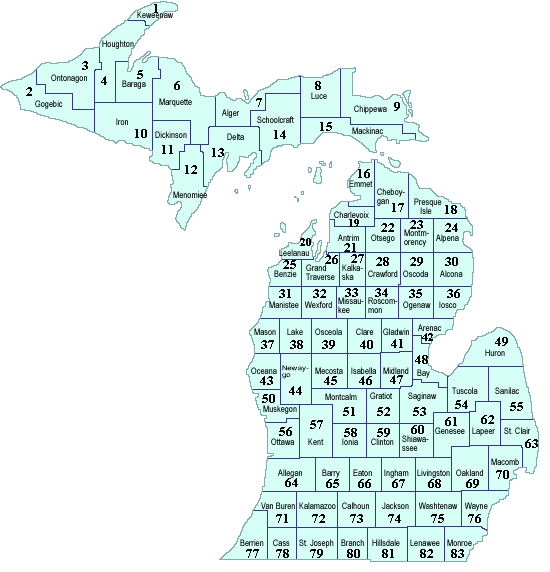
Three West Michigan counties are experiencing a Shigella outbreak, the Muskegon Chronicle reports. 

Eight cases of shigella have been confirmed in Muskegon County, said county health department director Ken Kraus. He said Kent and Ottawa counties also have confirmed several cases of shigella.

Kraus said shigella was likely being spread in Muskegon County for a month before lab results confirmed the first case.

He said budget cuts in recent years forced the county to reassign four nurses who monitored communicable diseases, including shigella.


Muskegon County now has just one nurse to track communicable diseases. Due to limited funding, that nurse can only track disease outbreaks over the phone — instead of visiting schools and other places where large numbers of people congregate, Kraus said.

Two of the three counties (50 and 56 on the map) border on Lake Michigan, and the other is immediately adjacent to the other two (57). 

Go here for more.


Up to 200 people in Sydney, mostly gay men, are infected with an antibiotic-resistant gut infection, according health officials in Australia. It has been identified as an outbreak of shigella by health clinics in the largely gay Darlinghurst area.

According to the Sydney Star Observer,  CEO Stevie Clayton of the gay advocacy group ACON said the faeces-transmitted bacteria was very infectious so gay men should start taking some extra precautions now to limit the spread and duration of the outbreak.

“It’s going to be either basic hygiene — washing your hands after going to the toilet — or it’s going to be sexual transmission or it’s food handling,” she told Sydney Star Observer.

“It’s passed on very quickly and easily. Because symptoms appear between 12 hours and four days, it’s often hard to tell where someone got it from, and friends who’ve done the same activities could get infected at a different rate.”

For more on where they are finding shigella down under, go here.

Lubbock, Texas was a sleepy panhandle town with a powerful radio station when Buddy Holly exploded on the music scene.   Today, its probably best known for the sprawling Texas Tech campus where Bobby Knight went to coach college basketball before he retired earlier this year.  Bobby Knight was also known for exploding occasionally.

The latest explosion in Lubbock is the the number of shigellosis cases. KCBD-TV 11, the local NBC affiliate, reports on the numbers for the period between Sept. 6 and Oct. 3:

Forty-four cases have been reported during these dates. This is a five-fold increase over the expected 8 cases in a 30-day period. The cases range in age from 1 year to 75 years with 28 (63 percent) of the cases in children 1 to 15 years of age.  Twenty of the 44 cases are lab confirmed.   There are 24 probable cases among the household or classroom contacts of lab-confirmed cases. No common food source has been linked to these cases.

By contrast, between January and August of 2007, the Texas city reported only seven Shigella cases.   For the best background on Shigella to be found on the net, go here.