News 25, the NBC affiliate in Central Illinois, is reporting a Shigella outbreak is occurring in Tazewell County.   The number of Shigella cases so far this year stands at 18, and that compares to only one during the year 2007.

News25 reports that:

Shigella is caused by a group of bacteria that health officials say can be avoided by hand-washing, sanitary food handling and diaper changing, eliminating shared water play areas, and staying home when diagnosed. Those diagnosed with the bacteria are urged not to return to school or daycare for 24 hours after being symptom free.

The bacteria is spread through the fecal-oral route and is more typical in young children and those who live in crowded conditions.

Signs and Symptoms to look for are similar to the flu. Loose watery stools with blood or mucus, fever, headache, convulsions, and abdominal pain can be associated with the bacteria.

There is not a reliable link to the story.  News 25 can be found here.


All those Clinton and Obama campaign workers may be getting out of Ohio just in time.  Or maybe not.

Akron health officials are reporting that Ohio is suffering from the largest number of shigella cases since the 2001-2002 school year.    They say its been ongoing for several months with youngsters battling diarrhea caused by shigellosis, a highly contagious, bacterial infection.

The Akron Beacon Journal quoted Dr. Marguerite A. Erme, an epidemiologist for the Akron Health Department, as saying that about every five years, day-care centers and schools throughout the state report a rise in children sickened with shigellosis.

Erme said, like clockwork, the bacteria is back and many parents, teachers, and day-care providers can attest to that fact.

The Akron Beacon Journal reports:

”It is characteristic of this particular germ that we do see it cyclically,” she said. ” . . . Since the fall, we started seeing an increasing number of cases of shigella throughout the whole county.”

Signs of shigellosis include diarrhea (often bloody), fever and stomach cramps starting one or two days after exposure to the bacterium, according to the Ohio Department of Health. Symptoms typically resolve in five to seven days, though young children and the elderly sometimes require hospitalization if they experience severe diarrhea.

A stool sample is required to confirm the presence of the shigella bacteria, Erme said. Severe cases can be treated with antibiotics, though that’s not always necessary for milder cases.


The rest of the story can be found here.

A million children are killed annually by diarrhea disease caused by Shigella and Escherichia coli (E coli).

The Info Project at the Bloomberg School of Health at John Hopkins University just published a fact sheet on "Developing New Vaccines Against Diarrheal Disease" by PATH.   It seems that PATH, an international nonprofit organization, last year was on the receiving end of a $50 million grant from the Bill and Melinda Gates Foundation  "to protect infants and children in low-resource countries by advancing development of safe, affordable, and effective new vaccines for two of the most important bacteria that cause diarrheal disease."

PATH’s Enteric Vaccine Initiative will collaborate with private- and public-sector partners to advance the development of safe and effective vaccines against the leading bacterial causes of diarrheal disease: Shigella and enterotoxigenic Escherichia coli.

According to the fact sheet,  the PATH project is looking at several ways  to produce effective vaccines, including killing the whole cell, subunit or conjugate polysacchardie-based, live attenuated strains, and bacterial vectors.  "Preventive vaccines designed to be practical for low resource countries are a high priority," the PATH fact sheet says.

PATH says diarrhea is the second leading cause of death in children age five and younger. Each year, almost two million children throughout the world die from severe, dehydrating diarrhea, and millions more are hospitalized.   Half of those deaths are due to Shigella and common E. coli.

 The Info Project abstract on the PATH fact sheet can be found here.

Martha Gesegnet, RN, is a blogger who writes for The Natural Health Maven.   She recently wrote about friends who were quarantined in the home with an outbreak of shigella. 

Nurse Gesegnet writes:

It seems that her 4 year old contracted
"Shigella" at a movie theatre. Shigella is
a rapidly speading intestinal "bug".

And as such, it quickly made it’s way to her 2 year old,
6 year old and of course, to mom.

It is mandatory that Shigella be reported to the Center for
Diseaes Control. Her kids are not allowed back in school
until they all have negative, well, her quote, "poop" specimens.
I won’t even go into that tale.

The importance of all of this is….. no one really told her
some of the things she needed to know, and as
a result she and her family have been through tremendous
stress, strain, and suffering. Some could have been
avoided, and this may have been resolved much sooner!

Her doctor said, "just make sure they wash their hands"

But every one knows that 3 young kids who run,
and hug, and touch, and play are spreading germs every where.

And what about the car, and car seats?

Could 2-3 weeks of quarantine been avoided? I think it’s likely.

The nurse goes on to advise cleaning house and using "essential oils."  We not sure about the faith she puts in some of this stuff, but it makes for interesting reading and can be found here.

If something will "Play in Peoria," it usually means that the rest of the country won’t be far behind.  Let’s hope that’s not true this time, however, as Peoria is experiencing a worrisome uptick  in its reported cases of shigella.
Frank Radosevich II, writing in the Peoria Jounral Star, drills down on the numbers:

Randall McClallen, communicable disease coordinator, said the department fields between 20 to 30 reported cases each year. In the past three to four months, however, about 60 cases have been reported, though not all of the cases have been confirmed. So far, no definite connection has been found between the cases.

"They haven’t been linked to any one specific place," McClallen said. "It’s been across all age groups. It’s just been here and there."

So far, counties surrounding Peoria are not experiencing the outbreak of shigella cases.  Woodford County hasn’t had any cases this year or last, and Tazewell County has seen four cases this year compared to one in 2007, local health officials said.

Typically there are about 1,300 shigella cases in Illinois each year, and about 18,000 in the United States.  For the complete Peoria Journal Star story, go here.


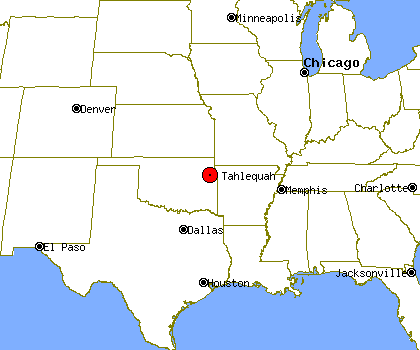
Tahlequah, Oklahoma is probably best known  for being the headquarters of the Cherokee Nation. Yesterday, the Tahlequah Daily Press reported that a pre-school there sent its students home after one was infected with "a common bacteria"—shigella.

Just how "common" is shigella in Oklahoma?   The Oklahoma Department of Health reports there were 575 confirmed cases of shigella reported in the state, on an average annual basis, from 2001 to 2005.   The data is contained in the department’s Epidemiology Bulletin, Vol. 38, No. 3 found here.

Meanwhile,  Josh Newton at the Tahlequah Daily Press reports that:

Students at the Cookson Hills Head Start program at Keys School were sent home Monday when school officials learned one of the children had developed a bacterial infection common in Oklahoma.
Keys Superintendent Jerry Hood said the child became ill and had frequent bouts of diarrhea. The seven children in the program Monday were sent home, while the school called in a crew to sterilize the classrooms and carpet, as required in such situations.
Health officials confirmed after the cleaning process that the room was bacteria-free.
The ill child apparently had Shigellosis, a common infection of the gut caused by the Shigella bacteria.

The rest of the story can be found here.


Health officials in Marion County, Indiana are hoping the Christmas & New Year’s break from school will also help break the back of a serious uptick in Shigella cases in the Hoosier State capital city area.

Prior to the winter vacation, Indianapolis health officials were warning residents to wash their hands after noticing "a spike in the number of cases of a highly contagious infection that causes bloody diarrhea and fever.

"

As it prepared to close out the year, the Indianapolis Star reported that: "So far this year in Marion County, there have been 107 cases of shigella, a bacterial disease transmitted only by humans. Last year at this time, the county had had 58 cases."

Star health writer Shari Rudavsky went on to report that:

"We have been seeing an increase in the last several weeks, so we’re concerned about that," said Dr. Crystal Jones, medical director of the acute disease program for the Marion County Health Department.
"We certainly want to nip it in the bud and control the situation before it gets worse."
Not only are county officials advising people to take particular care in washing their hands after using the bathroom and before handling food, they’re also asking health-care professionals to be vigilant in testing for suspected cases of the disease.
"And they’d like people who have symptoms of the disease to stay home from work or school to avoid infecting others and practice good hygiene to keep the bacteria from spreading to family members."
Marion County was the site of a huge Shigella outbreak in the year 2000 when there were more than 1,300 cases reported.   Most of its 2007 cases came late in the year.  There are about 18,000 cases of Shigella reported annually in the United States, according to the Centers For Disease Control.
The current round of cases have been centered in some day cares, schools and families.

Parents of children who attend Roberts Elementary School in Fond du Lac, Wisconsin, received letters this week regarding a Shigella outbreak at the school.  At least 14 people have become ill with shigellosis since the outbreak began, and parents were warned of the symptoms of Shigella infection and were asked to keep kids home from school and daycare if they exhibit symptoms of the illness. 

According to the Fond du Lac Reporter, all cases reported so far involve children, their household contacts, or daycare and school staff. 

Symptoms of Shigellosis:

Most people who are infected with Shigella develop diarrhea, fever, and abdominal cramps. Severity of the disease ranges from mild to very severe diarrhea. Diarrhea is bloody 25-50% of the time and most often contains mucus. Rectal spasms, medically termed "tenesmus," are common. The illness starts 12 hours to 6 days, usually 1-2 days, after exposure. Dehydration is also a common symptom of Shigella infection.

Shigellosis is more severe than other forms of gastroenteritis. This is because when Shigella bacteria multiply in the human gut they invade cells and result in much tissue destruction. Also, many strains produce a toxin called "shiga toxin" which is very potent and destructive. Shiga toxin is very similar to the verotoxin of E. coli O157:H7.

Complications of shigellosis include severe dehydration, seizures in small children, rectal bleeding, and invasion of the blood stream by the bacterium.  In addition, up to 3% of persons who are infected with Shigella may later develop a syndrome that includes joint pain and swelling, irritation of the eyes, and sometimes painful urination. This is a reaction to the previous gastroenteritis and is called “reactive arthritis” or Reiter’s Syndrome.

The Associated Press reported that Mississippi is experiencing an increase in the number of Shigella cases reported in comparison to last year’s numbers.  According to the Mississippi Department of Health, at least 103 people have been confirmed ill with Shigellosis in Harrison, Hancock, Jackson, Pearl River, Stone, and George Counties.

The spread of Shigella from an infected person can be stopped by frequent and careful hand washing with soap and water. The ill individual should practice this, as well as any contacts. Supervised hand washing of all children should be followed in day care centers and as soon as children return home. Young children with a Shigella infection, or with diarrhea of any cause, should not be in contact with uninfected children.

If a child in diapers has shigellosis, everyone who changes the child’s diapers should be sure the diapers are disposed of properly in a closed-lid garbage can, and should wash his or her hands carefully with soap and warm water immediately after changing the diapers. After use, the diaper changing area should be wiped down with disinfectant, such as household bleach or bactericidal wipes.

At swimming pools, maintaining a chlorine level of at least 0.5-PPM will kill Shigella. At swimming beaches, children not yet toilet trained should be excluded from public swimming areas; stay clear if this rule is broken. Children with diarrhea should never be taken to public swimming areas.

Basic food safety precautions will also help to prevent shigellosis. Shigella organisms are killed by heat used in cooking. People who have shigellosis or any diarrhea should not prepare food for others until they have been shown to no longer be carrying the bacterium.

Drink water only if it has been chlorinated (most tap water) or treated with ozone (most bottled water) and then you know it will not contain pathogenic bacteria. Consume only pasteurized dairy products.

In the developing world, shigellosis is far more common and is present in most communities most of the time. Simple precautions taken while traveling to the developing world can also prevent getting shigellosis. Drink beverages only if they are imported (e.g. Evian), carbonated (e.g. cola – without ice), boiled (e.g. coffee) or have been in contact with alcohol for a prolonged period (e.g. wine or beer, not mixed drinks). Eat a cooked diet with the exception of fruits you peel yourself.

WATE reported this morning that at least ten children in Knox County schools have become ill with Shigellosis, an illness caused by the Shigella bacterium.  Because it is easily spread in young children, the Knox County Health Department is warning parents to be aware of the signs and symptoms of Shigellosis.  As reported by WATE:

The Knox County Health Department confirmed on Thursday there are seven cases at Powell Elementary School, one at Inskip Elementary and another case involving a two-year-old.

Health officials say shigellosis isn’t just a concern for schools. It could become a problem for the community because it’s so contagious.

While shigellosis usually resolves in five to seven days, it may be several months before an affected person’s bowel habits are entirely normal. In some persons, especially young children, the elderly, and immune compromised persons, the diarrhea can be so severe that the affected person needs to be hospitalized for dehydration.

It is estimated that over 6,000 hospitalizations for shigellosis occur each year in the U.S. Complications of Shigella infection include severe dehydration, seizures in small children, rectal bleeding, and invasion of the blood stream by the bacteria. In the U.S., it is estimated that about 70 persons die yearly from shigellosis, with small children and the elderly at greatest risk of dying.

More can be learned about Shigella and Shigellosis at Foodborneillness.com.